
Baseline, Assessment, Transformation: The 3-Part Architecture Every LFS Program Runs On
Why LFS doesn't build a program until your body has been measured. The system most coaches skip — and what changes when they don't.

The default of the fitness industry is a 12-week program prescribed in 12 minutes.
Fill out a form. Pick a goal. Pay. A PDF lands in your inbox by Friday. Sometimes the only customization is the client’s name at the top of the document. Sometimes there isn’t even that — just a template branded as personal, sold by the volume of how many people pay for it.
That works for a 25-year-old with no injury history, a decade of training capacity behind them, and a body that recovers between sessions whether or not the programming is thoughtful. It does not work after 40.
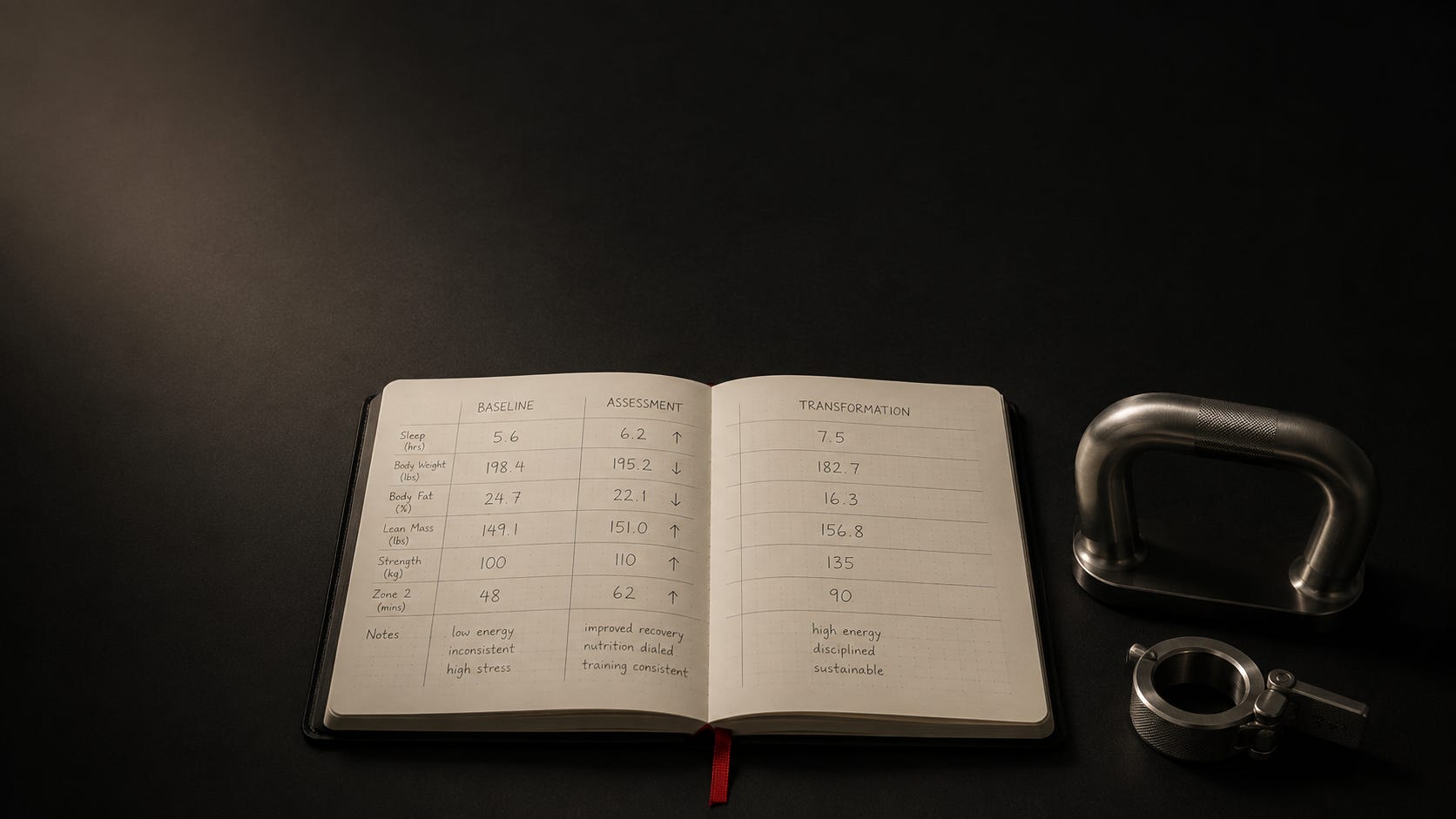
After 40, the math changes. The cost of a templated program isn’t visible in week one — it shows up in week eight, week twelve, in a tweaked back that takes four months to settle instead of four days, in twelve weeks of accumulated risk no one signed up for, paid for under a banner that promised the work was specific. The architecture of Legacy Fitness Solutions exists because that math is non-negotiable. Every LFS program runs on the same three-part system: Baseline. Assessment. Transformation. BAT. The B and the A come first. Without them, the T is a guess that took longer to write.
This is what each one is, and why none of them are optional.
Why most programming fails after 40
The American College of Sports Medicine has been telling coaches to individualize exercise prescription since 2011. The ACSM Position Stand on exercise prescription is unambiguous — training prescription should be individualized to the participant’s measured capacity, physical function, health status, exercise responses, and stated goals. Not assumed from age. Not assumed from sex. Not assumed from training history.
Fifteen years of published guidance. Most of the industry still hasn’t moved.
The reason isn’t disagreement. The reason is friction. Individualized programming requires data the coach doesn’t have on day one, an hour of structured work before the work, and a willingness to look at what the body is actually telling you instead of what the marketing template assumes about it. Templated coaching is fine for someone with no injuries, no constraints, and twenty years of training history. It’s a different category of risk after 40 — where movements you can’t load enough to adapt to and movements you load past what the tissue can absorb both compound quietly into a program that costs more than it returns.
The fix isn’t a better template. The fix is a system that refuses to start without data.
B — Baseline
Baseline is the hour before the program.
When LFS says baseline, here’s what gets measured: strength under submaximal load across compound patterns — squat, hinge, push, pull, carry — with attention to form quality, end-range control, and asymmetries the body has learned to hide. Mobility, joint by joint — hip flexion and extension, thoracic rotation, ankle dorsiflexion, overhead reach. The joints that gate everything else. Aerobic capacity — a calibrated submaximal field test, not a VO2 max in a lab, but a working number that future programming can build off. Equilibrium — single-leg balance, eyes open and eyes closed. The capacity that decides whether you fall in your seventies. Trainable. Testable. Almost universally untested. And training and injury history, in detail — what’s been loaded, what’s been avoided, what flares up when, what twenty years of training did and didn’t do to the body underneath.
That hour produces a written record. Numbers, photos, video where useful. It becomes the reference point every program decision gets made against. Re-tested at 8 weeks. Re-tested at 16 weeks. Re-tested at every program block transition.
The point isn’t the number. It’s that there’s a number now.
A — Assessment
Assessment is what the data says.
A baseline is inert without it. Numbers collected and ignored are no better than no numbers — they sit in a file, and the program gets built around the assumption the form clarified. Assessment is the step that turns the baseline into a plan. Where to start. What to defend. What to build. What to wait on. The 26-year pattern, more clearly than any single dataset: the coaches who skip this step build programs that fail within twelve weeks and the clients who absorb the cost are the ones who can least afford the setback.
The clients who eventually sustain training into their 60s and 70s aren’t the ones who started the hardest. They’re the ones whose first program was built around what their body actually told us — not what someone assumed it should do at their age. Assessment is what makes that possible. It takes about an hour. It is not optional.
It is the A in BAT.
T — Transformation
Transformation is the program built from real data.
Not a template with the right name at the top. A program that knows where the strength baseline is and where it needs to be by week four. A program that knows which joint can absorb load and which one needs to earn it back before it’s asked to. A program that knows what the aerobic engine can handle in week one and how to escalate it without producing the kind of fatigue that makes everything else collapse. A program that knows what the equilibrium baseline is and treats balance as trainable capacity instead of background hope.
It is also a program that re-baselines. Eight weeks in, the data gets pulled again. Sixteen weeks in, again. Every block transition, again. The architecture doesn’t assume the body that started the program is the body that finishes it — because it isn’t, and a program that pretends otherwise is just a slower template.
This is what makes transformation an actual outcome instead of marketing language. The work is specific. The work changes when the data changes. The work is built around the body in front of it, not the body the program assumed.
The 26-year pattern
The pattern that repeats more than any other has nothing to do with discipline, willpower, or starting condition. It has to do with the first hour.
The clients who sustained training into their 60s and 70s — the ones who kept training through orthopedic events, life events, the slow accumulation of everything that makes consistency harder over time — weren’t the loudest starters. They weren’t the ones who could squat the most in month three. They were the ones whose first program was built around what their body actually told us, and whose programs kept getting rebuilt around what the body kept telling us. They had a number to train against. Their coaches knew what the number was. The work was specific to it.
The clients who dropped out — and there have been some — were almost always the ones whose first program was a guess that took longer to write.
Closing
A program that doesn’t start with your data isn’t a program. It’s a template wearing a clipboard.
The BAT System exists because the step the industry skips is the step that determines whether anything else works. Baseline. Assessment. Transformation. B and A come first. Without them, T is a guess.
This week, The Long Carry went live — a small Skool community for adults 40+ training to stay capable for decades. Named after the FACE Framework pillar that defines what physical capacity actually means after 40. The room runs on weekly drops, monthly office hours, and the work made visible. Built to Endure is the thinking. The Long Carry is the room.
If you’ve read enough to know you want the assessment itself, the BAT consult is the next step.
— Stephen
Built to Endure.
Source: Garber CE, Blissmer B, Deschenes MR, et al. Quantity and Quality of Exercise for Developing and Maintaining Cardiorespiratory, Musculoskeletal, and Neuromotor Fitness in Apparently Healthy Adults: Guidance for Prescribing Exercise. Medicine & Science in Sports & Exercise. 2011;43(7):1334–1359. ACSM Position Stand.